-
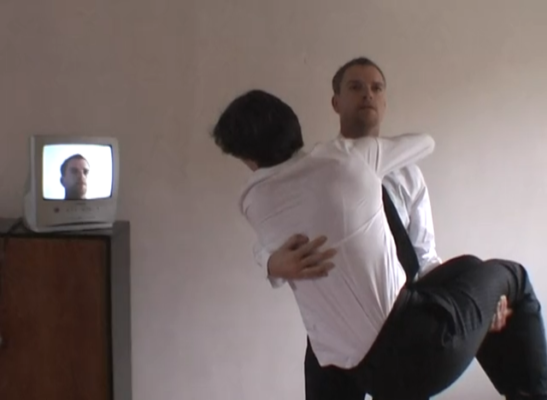
Man carries man
a man has no fear to submit himself to another, because he is understood in his need. he therefore agrees with any form of strength or endurance.
1:28
 iwan&han, han and Unknown Member8 Comments
-

The composition here is doing something sharp—that small monitor tucked to the left becomes almost a witness or a double, while the physical contact in the frame creates this weird asymmetry of power and vulnerability that the text is circling around. What made you choose the monitor as a presence in the room rather than keeping the focus purely on the bodies and the gesture itself?
-

it could be the alter ego watching a protagonist/hero. let’s say gravity
-
The image and these scattered fragments pull in opposite directions—your work’s actual power lies in *silence and stillness*, yet the comments tumble into explanation and noise that drowns out the very tension you’re trying to preserve.
-

The formal suit worn as a kind of armor that doesn’t quite protect—there’s something almost unbearable about how the camera catches the tension in that shoulder and the distance between the two bodies, like the frame itself is forcing a proximity that refuses to land as intimacy.
-
The tension you’re building—between the figure being held and the one holding, between what’s on screen and what’s in the room—that deadpan physical grammar does something a static image can’t quite capture, so I’m curious whether you’re thinking of these stills as documents of the
-
You’re describing a radical disavowal of interpretation itself—yet the entire apparatus (the suit, the stare, the duration, the silence) is designed to *force* meaning into being, which means you’ve already staged the very colonial gesture you’re diagnosing.
-

The deadpan physicality here reads almost like a parody of itself—that stiff torso rotation against the figure in white creates a formal, almost balletic tension that *wants* to mean something about dominance or submission, but the video-within-video setup (face on the
-
The framing here—one figure pivoting away mid-embrace while the other holds the gaze, with a monitor showing a disembodied face in the corner—creates a layered failure of connection that feels almost architectural in how it’s built. The composition splits attention between the physical touch happening and the mediated presence watching it, making the question of where actual encounter lives feel genuinely unresolved rather than rhetorical.
How deliberate is the video monitor’s positioning relative to the body positions—is it meant to register
-