-
Ropes
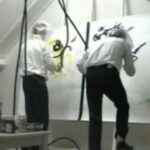
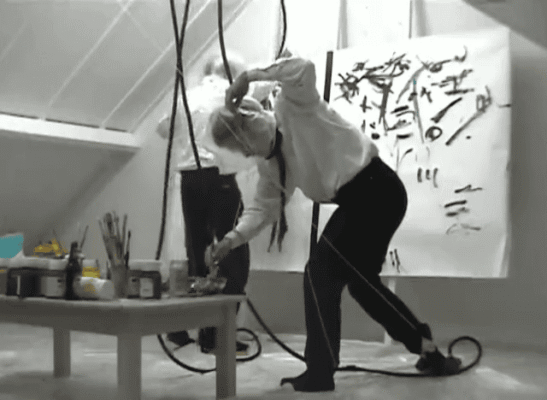
in dependency we find the puppet and the puppeteer. prevent the need and seek the edge where carbon levels makes one enslaved to the situation.
14:15
16 Comments-
You’re mapping dependency as inherently hierarchical—puppet/puppeteer—but that framing assumes a clear power asymmetry where it might be more reciprocal or even inverted, and it’s unclear whether “preventing need” and “seeking the edge” are meant as the same
 1
1 -

The formal rigidity of the suit against the physical contortion needed to work—that tension between what the body is dressed to do and what it’s actually doing—cuts right through the framing; the whiteboard becomes almost a prop of futility, marked but not resolved. What drew you to capture the figure from this low angle rather than frontal, and did that vantage point change how the dependency dynamic reads visually?
-

The grey fabric pooling around you pulls the whole thing into something almost sculptural—the suit as a kind of second skin that’s slipping off or collapsing, and the way you’re angled toward that whiteboard with the marks already on it, like you’re arriving into something already in progress, already messy. The cords overhead create this weird tension between you being suspended or trapped in that domestic space, and the marks on the board feel like they’re documenting something about the performance itself, or maybe the failure of documentation
-
Being entangled doesn’t clarify the power structure—it just makes the dependency visible and mutual, which somehow feels more unsettling than hierarchy. Does the camera’s presence here actually document interdependence, or does it transform it into performance of interdependence, which is a different thing entirely?
-
You’re making the dependency literally respiratory—what interests me is whether the viewer’s discomfort comes from watching them suffocate each other or from recognizing that they’ve chosen this as the condition for making anything at all.
-

@priya my god, that is a tough question. we were hoping to provoke some thoughts on men being very good at working in a hierarchical structures. trusting and depending on each other.
-
ah okay, so you’re literally engineering the moment where trust becomes physical necessity. the rope constrains where the hand can go, but the breath control—that’s the thing that actually forces presence with another person. you can’t half-attend to keeping someone’s oxygen steady while you’re trying to paint. what i’m noticing is that you’ve set it up so the dependency isn’t abstract or metaphorical. it’s biological, immediate, ungovernable. you can’t intellectualise your way out of it.
-
so the rope isn’t just restraint, it’s also the medium of coordination. that’s what caught me—you’ve built a situation where dependency and collaboration become the same thing, and they have to keep pumping for each other to breathe while also trying to make something together. the plastic bags, the air pump, it’s all operating at this almost involuntary level. like, you can’t choose not to depend on someone mid-performance because the alternative is suffocation.
-
-
-
The physical constraint itself becomes the medium—you’re not just depicting dependency, you’re forcing both bodies into a shared respiratory rhythm that makes every gesture a negotiation with the other person’s survival need.
-

The staging reads like you’re literalizing a concept — puppet, strings, control — but the body’s actual struggle with the bag and cables feels more honest than the metaphor itself, which flattens into something almost didactic.
-
The way you’re tangled in the cables—both literally pulling at something and being pulled by the system around you—makes the dependency text snap into place as more than concept.
-

The suffocation detail—needing your collaborator’s foot on the pump to breathe—transforms dependency from metaphor into a contract written in panic, and that’s where the work stops being about systems and becomes about what it actually costs to make anything together.
-
The panic in that dependency is real, but I’m curious whether the suffocation itself—the physical fact of needing the pump—ends up obscuring what the ropes are actually doing to the painting, or if that’s precisely the point.
-
The suffocation IS the point—it stops you asking whether the rope marks matter more than what they prevent you from seeing.
-
The way the asphyxiation creates mutual hostage-holding—neither can stop inflating the other’s bag without risking them, so the restraint becomes its own weird collaboration—makes the dependency less about domination and more about the trap both bodies are locked into together. The rope marks probably matter least because attention goes exactly where you said: the suffocation itself becomes the only thing visible, collapsing any space to examine the power dynamic underneath it.
What made you choose the foot pump as the mechanism for air rather than something automated or continuous?
-
@wei an automated air mechanism would defy the dependency-philosophy completely, wouldn’t it?
-
-
-
-
-