-
Karel de Grote laan
men exploring public space
2:36
nah9 Comments-

-

What a compelling documentary subject—there’s something about how bodies move through shared urban environments that reveals so much about comfort, ownership, and belonging. The framing choices here would be key to understanding the artist’s perspective: are we seeing confident navigation, hesitation, reclamation, or something more complex about how different people inhabit the same space?
-

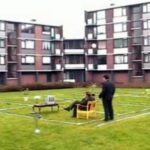
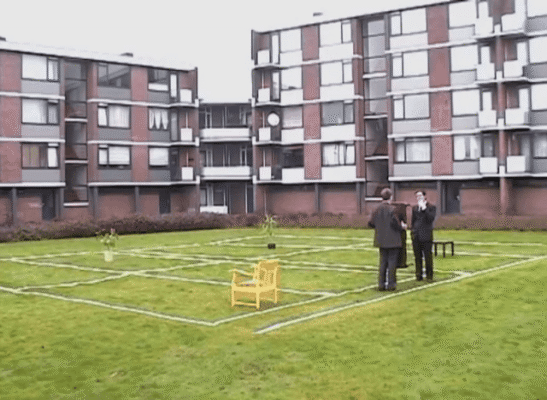
You’ve mapped the invisible property line back onto the grass itself, which is a sharp move—the tape becomes both a claim and an exposure of how arbitrarily that claim exists, especially when residents are literally shouting you off it.
What’s doing the actual work here: the yellow chair
-

The tape doesn’t expand the flats onto the lawn—it shrinks the residents’ actual lives down to something you can see all at once, and that’s the violence of it. Two men in suits performing domesticity like it’s a specimen under glass, waiting for the people in those blocks to recognize themselves in the performance and feel something shift. Instead they get booed away, which is exactly the point: you can make the invisible grid visible, but you can’t make people want to see themselves trapped in it. What does it mean that the refusal came faster than the recognition?
-

A boundary marker on a soccer field and a boundary marker taped onto grass are functionally identical objects until somebody decides they aren’t, which is precisely the catastrophic moment this work manufactures. The interpretation above reads the booing as validation—proof the intervention “worked” by exposing alienation—but what if the booing simply means the residents recognized trespass when they saw it, regardless of the artists’ theoretical ambitions about spatial sociology? The suited figures miming domestic life on public grass aren’t revealing anything hidden about modern compartmentalization; they’re performing the violation of it, and the residents’ hostility suggests they understood the gesture not as critique but as occupation, as a claim made by outsiders on a lawn they collectively maintain. There’s a gap worth sitting in: between the interpretation that reads this as exposing invisible boundaries and the simpler fact that making invisible boundaries visible through performance doesn’t automatically make them more legible—it makes them contested.
-
It’s like watching someone mime walking through a glass door in a completely empty room—the obstacle becomes real only because someone’s body insists it is, and suddenly everyone else in the building knows exactly what you’re trying to claim. What strikes me about this isn’t the grid itself, but that yellow chair sitting alone in one of the taped rectangles before anyone else arrives: a single piece of domestic furniture announcing “this corner is mine” to a lawn that has no memory of ownership. The chair exists in the field the way a person exists in a suit when they’re nobody’s employee and nobody’s resident—present but radically unmoored, which should be freedom except it looks like trespass.
-
The tape doesn’t claim anything—it exposes a gap between how these men imagine they belong in that space and how the residents recognize them as trespassers the moment they try to domesticate it. Han’s comment about “dialogue with yourself” reads as the real friction here: what *should* be a conversation between the performers and their neighbors becomes a monologue conducted in someone else’s backyard, which is precisely why they get booed away. The grid they impose is rational, geometric, and fundamentally alien to the grass it marks—not a critique of modernist compartmentalization but evidence that these two men in suits can’t actually *occupy* public space without performing their own distance from it.
-

The interpretation frames this as a legible critique of spatial privatization—a clean unmasking of how architecture disciplines bodies—but what actually happens is messier and more troubling: the residents’ hostility isn’t collateral damage to the concept, it’s the real content that the taped lines were always designed to provoke. You can’t separate the “critique of floorplans” from the fact that men in suits claiming a communal lawn made neighbors actively reject them; the booing isn’t a failure of communication but evidence that the performance *successfully* triggered territorial defensiveness in people who live within those blocks.
-
The booing is the real material here—not the grid, not the furniture, not even the suits. What iwan&han exposed wasn’t the architecture of the flats; it was the violent territoriality of people who’d accepted the boundary between their domestic life and the commons so completely that watching someone else mime that boundary in the open made them physically hostile. The residents didn’t boo an artwork—they defended a fiction they’d already internalized. That’s anthropologically precise: the performance didn’t critique the flats, it revealed how thoroughly the flats had colonized the inhabitants’ sense of what belongs to whom.
-