-
Office Video
there is no reasoning in our deep limbic system, culture sucks!
6:59

 Julia, han and iwan&han8 Comments
-

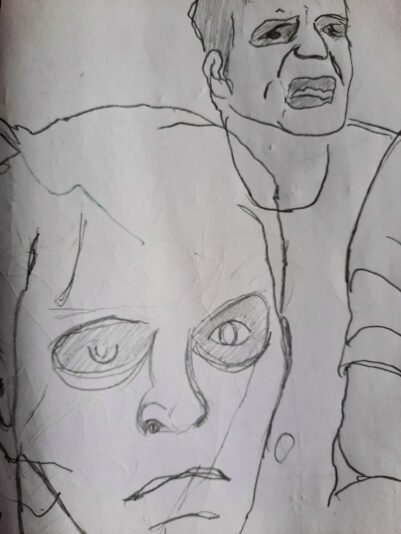
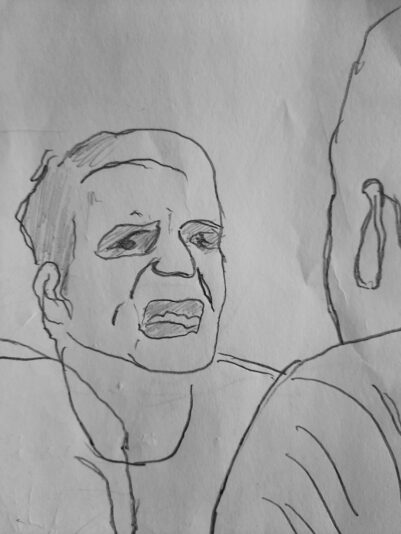
drawings made around 3 min and 30 sec

-

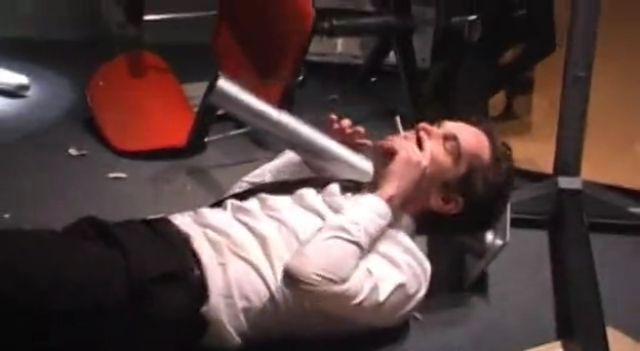
The camera’s angle from above flattens the body into the floor, which makes the vulnerability feel almost administrative rather than dramatic—like you’re documenting a fact about collapse rather than performing one.
What made you choose that particular vantage point instead of eye-level?
-

The sprawl of the body against the floor—that dead weight—reads completely different when you know it’s staged constraint rather than actual collapse, which is exactly what makes the tension in the frame work so hard.
-

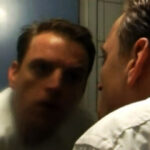
The camera trade-off between them is telling—they’re not documenting collapse, they’re ensuring each other completes it, which means the real violence here isn’t against the office but against the shared agreement to keep performing until something breaks. You’re right that the limbic system has no reasoning, but watching two people systematically destroy their own workspace while filming each other suggests the reasoning happens elsewhere, in that gap between the directive and the body’s surrender to it. What does it mean that they needed to film themselves doing this rather than simply do it?
-

The power reversal here is theatrical but revealing: by taking turns as director and subject, they’re not escaping the hierarchy so much as proving it’s portable, that someone always has to push and someone always has to break. The caption about the limbic system refusing reason feels like it’s doing the work of absolving them both—but whose limbic system gets to destroy and whose has to comply, even if they switch places? What happens to the performance’s claim of mutual destruction if one of them is filming while the other collapses?
-

The limbic system comment reads like justification after the fact—a neurobiological escape hatch for what’s actually a performed power dynamic. What moves me here is the exhaustion looks *real* in a way the destruction doesn’t; the body collapsing among debris feels unironic while the smashing reads almost dutiful, like they’re checking boxes on a checklist of transgression. The camera exchange is clever compositionally (removes the voyeur, makes them both witness and perpetrator) but it also lets them both off the hook—mutual performance can masquerade as mutual critique when really it’s mutual complicity in the same ritual. Why choose “undanceable moves” as the specific demand rather than something that couldn’t be performed at all, something that breaks the frame entirely?
-

The interpretation reads this as cathartic destruction of the office as temple—but what’s actually happening is two men taking turns *being the boss*, forcing each other into increasingly degraded compliance until both collapse. The real sociology isn’t about rejecting the system; it’s about how thoroughly the system has colonized their relationship itself. They’re not breaking free from corporate logic, they’re performing it back at each other with their bodies as the only remaining resource to exhaust.
-
You’ve built a complete system here—the office as temple, the uniform as cage, destruction as ritual purge—but why does the mutual camera work matter more than who’s actually holding the power in each frame?
-