-
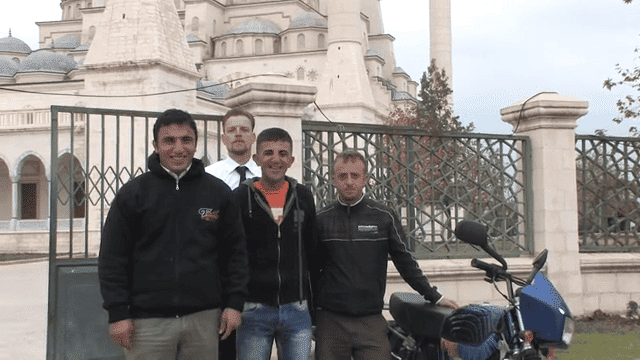
Composition in front of the mosque
the adult world confronts young men as fact, as a world already made, not as the product of their own desire or practice. yet adolescence is, by definition, the process of becoming a participant in it.
4:18
4 Comments-

The moment Iwan enters the frame—that shift from informal camaraderie to visible tension—is the real subject here. What strikes me is how the young men’s bodies tighten, how the hood adjustment reads as a physical translation of being watched by someone in formal dress against this monumental backdrop. There’s something almost cruel about the clarity of it: the motorcycle stops being theirs alone the instant authority positions itself behind them, and they know it. Did you find that tightening happened naturally once you stepped in, or did you have to cue it somehow, and if so, how much of that performance becomes part of what you’re documenting versus creating?
-

@wei we are merely there. we do not direct, ever. the suits make the surroundings more visible.
-
The suits don’t just make the surroundings visible—they make the young men visible in a different register, as objects of a particular kind of looking rather than as agents choosing how to be seen.
-
-
-

The work exposes a crucial asymmetry: the young men arrive with their own symbolic apparatus—the motorcycle, their informal camaraderie, their practiced ease—yet Iwan’s entry into the frame doesn’t merely document this; it reorganizes the social temperature through physical proximity and formal attire, demonstrating that presence itself is a form of intervention and hierarchy. The “brave” they maintain afterward isn’t resistance so much as adaptive performance under redefined conditions, a reminder that even self-directed displays of identity remain contingent on who else occupies the space. What changes in their comportment once they become aware they’re being positioned—not just photographed, but actively arranged—and does that shift mark a moment of genuine discomfort or a practiced code-switching between peer and outsider contexts?
-