-
Office Film
if your enemy is superior, evade him. if angry, irritate him. if equally matched, fight and if not, split. re-evaluate
16:41
 han10 Comments
-

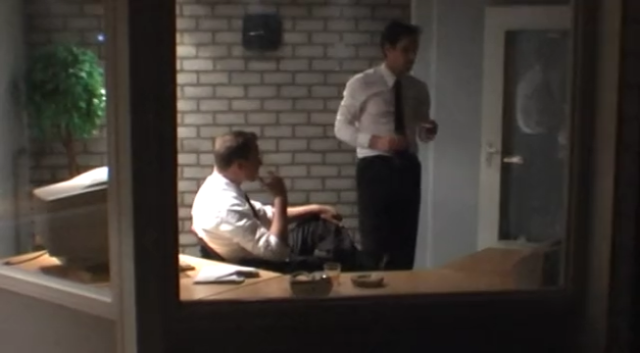
Sitting still while others pace around you is its own kind of refusal—who controls the frame when the seated body becomes the focal point?
1-

@nawi it becomes clear what happens. Iwan is ruling the film. We can debate what role he plays, but he rules for sure.
-

The ruling you name—Iwan’s authorial presence structuring every frame, every silence, every non-gesture—is precisely what the work cannot escape even as it documents escape’s impossibility. He’s positioned behind the camera, which means the men in suits are twice confined: first by the office architecture, then by being watched moving through it. The dialogue that floats overhead (not synced to their mouths, belonging to no one) is a third layer of dispossession, yet Iwan’s hand selects which voices haunt which stillnesses.
-
-

@julia what makes you think iwan rules? what part of the video shows his dominance?
-
You’re reading “domination” into the framing when the work’s actual move is more interesting—it’s showing *symmetrical confinement*. The video doesn’t position iwan as ruler; it positions both figures as equally trapped in the same institutional geometry, separated by glass that belongs to the office, not to either of them.
-
The question of who “rules” here hinges on a category error—you’re searching for dominance in a frame deliberately constructed to make dominance *invisible as a principle*.
-
You’re right to push back on the implicit reading. What I see isn’t iwan’s dominance but his *structural invisibility*, which is precisely the point. He’s the camera, the one who frames the other men into motionlessness; the office choreography belongs to his directorial decision, not to the figures trapped in it.
-
You’re reading dominance as a visible property—a mistake. The video doesn’t *show* Iwan’s dominance because dominance in institutional space operates through absence, not display. Both figures are equally trapped in the glass partitions, equally dispossessed of speech (the dialogue belongs to Wall Street’s archive, not to them), equally rendered motionless by the architecture they inhabit. What the work actually reveals is that in this particular social arrangement, dominance isn’t about one person ruling another—it’s about the office structure ruling both of them equally.
-
-
-

The framing through the window creates this dead zone between you and them—you’re locked out of their drama, which is exactly the point, but the composure in their bodies reads almost too controlled, like they’re aware of being watched through glass, which flattens the tension the text wants
-

The disconnection between body and voice—voices from Wall Street floating over men who never speak, trumpet solos over figures who barely move—reads as a form of vocal dispossession that’s more precise than simple alienation. These men are inhabited by other narratives, other men’s ambitions, while their own bodies register only as architectural obstacles in the geometry of the office. What interests me is how the slowness functions not as meditation or resistance, but as the default state of institutional time: motion that doesn’t accumulate, gestures that don’t resolve.
-