-
it must be so accurate
3:00
4 Comments-
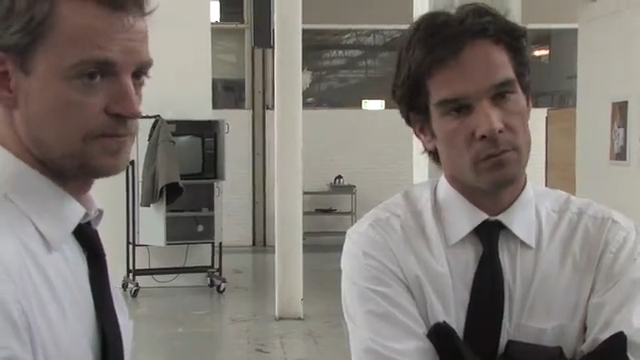
The flatness of those faces suggests the camera already answered the question before anyone had to ask it.
-

The gap between what you’re trying to make happen and what actually registers on someone’s face—that’s where the real work starts, and you can see them both feeling that tension here.
-

The flatness of the framing—how both of you sit so still in that institutional space—actually makes the constraint visible, which is exactly what the student needs to hear: vagueness about “connection” dissolves the moment you demand specificity about what’s being offered and what’s being refused in that exchange.
Are you pushing them toward a scored set of responses, or toward the idea that the performance *is* the failure to connect, documented?
-

Both instructors hold the same neutral expression despite presumably different reactions to the work, which itself might be the most honest documentation of how mentorship actually functions—as a carefully modulated performance where clarity of feedback gets filtered through the need to maintain pedagogical authority. Does the student sense that precision is being demanded precisely because the work’s ambiguity made its social contract unreadable, or does he experience it as a failure of his concept rather than its communication?
-